

Decide the limit before the first paid round
Choose an entertainment budget that you can afford to lose completely. Keep it separate from rent, bills, savings and money owed to somebody else. A session limit works only if reaching it ends the session; moving it after a loss defeats the purpose.
Set a time limit as well. An instant game can produce many paid actions in a short period, and repeatedly recycling small returns can create more total wagering than the opening balance suggests. If the operator offers deposit, loss or time controls, review which quantity each control measures before relying on it.
The demo is a better place to learn the interface. It lets you make control mistakes without using real funds. Becoming familiar with a button is useful; becoming convinced that a particular sequence “must” pay next is not.
Why a fixed stake is easier to evaluate
A fixed stake keeps the cost of each ordinary round understandable. If the balance falls, you can see how many comparable rounds remain without also accounting for repeated increases. This is an accounting benefit, not a change in the game’s probabilities.
| Illustrative plan | Cost before any returns | What it demonstrates |
|---|---|---|
| 20 rounds at 0.50 units | 10 units | A predefined count and cost |
| 20 rounds at 1 unit | 20 units | Doubling the stake doubles expenditure |
| 10 rounds at 2 units | 20 units | The same gross cost over fewer rounds |
| One optional purchase | The full displayed purchase price | Base stake alone may not describe the cost |
These examples ignore returns and do not recommend a stake. They show why a predefined count is easier to understand than playing until an arbitrary win appears. Check the permitted stake range in the live version.
Fixed fraction: a budget rule with changing stakes
A fixed-fraction rule uses a chosen share of the remaining session balance. With a hypothetical 100-unit budget and a 1% fraction, the first stake is 1 unit. After a complete loss the balance is 99 and the next calculated stake is 0.99. After a 3-unit return from that first 1-unit stake, the balance would instead be 102 and the next calculated stake 1.02.
This approach reduces the calculated stake as the balance falls. However, the game may not permit every decimal amount, so rounding and minimum stakes can interrupt the formula. Never round upwards repeatedly without recognising that the actual fraction is increasing.
Fixed fraction is a way to organise expenditure, not evidence of an advantage. Decide in advance when to stop rather than reducing the stake indefinitely to keep a losing session alive.
Compare the cost of a betting sequence
This calculation adds consecutive wagers with no returns. It shows cumulative exposure, not predicted outcomes.
Doubling does not guarantee recovery: Falling Pickaxe has variable payouts, and some are smaller than the round’s cost.
Multiplier calculator
Mathematical example, not a prediction. Net profit = gross return − stake.RTP does not reset after a losing run
At a theoretical 95% return, 200 units in total wagers correspond to an average theoretical return of 190 units over the mathematical model. The 10-unit difference is not a fee deducted from every session, and the next round does not compensate you because earlier rounds returned less than average.
Low volatility is not a protection against losing your budget. It describes a payout distribution, not a personal guarantee. Similarly, the ×160 maximum tells you the ceiling quoted by the provider, not how often you will reach it or how much you should spend trying.
Do not confuse total wagers with deposits. A 20-unit balance can generate more than 20 units of wagers if some returns are used again. Your financial exposure is easier to understand when you track the amount added, the amount withdrawn and the time spent, alongside individual round results.
The seven-cross rule is a tool guarantee, not a recovery system
The rules specify a pickaxe on the eighth spin after seven consecutive crosses. That is a real sequence feature and should not be confused with the general idea that a win is “due”. It guarantees a tool under that condition, not a particular tier, mineral layout or profitable return. The preceding round costs remain spent. Increasing the stake at that point does not establish that the next credit will cover either the new cost or the earlier losses.
Why chasing and doubling can make losses worse
A staking system changes the amounts you expose to successive rounds. It does not change the tool distribution, the minerals or the probability of a feature. Falling Pickaxe also has variable returns: a round can return zero, less than its cost, exactly its cost or more. That makes systems borrowed from simple even-money bets especially easy to misapply.
For every system below, classify a round by net result = settled return − full cost. A 2-unit round returning 0.80 is a loss of 1.20, even if the interface celebrates a win. The sequences are arithmetic illustrations, not predictions or recommendations to increase expenditure.
Martingale: doubling is not recovery insurance
A classic Martingale doubles after a loss: 1, 2, 4, 8, 16, 32. Six complete losses consume 63 units; the next stake is 64. Its familiar recovery argument assumes a successful bet returns the stake plus an equal net profit, that the next stake can always be placed, and that funds and limits do not intervene.
Falling Pickaxe does not offer that fixed even-money structure. After losing stakes of 1, 2 and 4, you are 7 units down. If an 8-unit round returns 1.5×, the credited 12 produces a net gain of 4 on that round, leaving the sequence 3 units down. A positive result did not recover the losses.
Partial returns make the accounting more complicated still. Doubling after a 0.6-unit loss on a 1-unit stake treats it as if a whole unit had disappeared. Increasing exposure is a poor substitute for tracking the actual deficit, and no deficit calculation improves the game's probabilities.
What each block pays
Minerals add payouts when destroyed. Dirt and stone consume durability but pay nothing. Multipliers apply to the round’s base stake.

Emerald
Pays ×5Durability: 30 HP
Diamond
Pays ×1Durability: 20 HP
Gold
Pays ×0.2Durability: 15 HP
Redstone
Pays ×0.05Durability: 10 HP
Copper
Pays ×0.01Durability: 5 HP
Dirt and stone
No payoutDurability: 1 HPExample: with a base stake of 2, one emerald at ×5 adds 10 to the gross payout. Subtract the full entry cost to calculate the round’s net result.
Reverse Martingale: increasing after positive rounds
A reverse Martingale, also called a positive progression, increases the stake after a profitable round and resets after a loss. With illustrative even-money results, winning at 1 and then 2 units creates a gain of 3. Losing the following 4-unit stake leaves the sequence at −1. The later stake can erase several earlier gains.
In Falling Pickaxe, define “profitable” using the net result rather than any nonzero payout. A 1-unit round returning 0.50 is not a reason to advance a positive progression. Also decide how many increases are allowed and what ends the session; otherwise a run of small positive results can lead to an unexpectedly large stake.
Calling the increased amount “house money” does not remove its value. Once credited and unrestricted, it is part of the balance you could choose to stop risking.
D’Alembert: slower increases still add exposure
D’Alembert raises the stake by one unit after a loss and lowers it by one unit after a win, usually with a one-unit floor. Under hypothetical even-money returns, losing 1, losing 2 and then winning at 3 produces −1 −2 +3 = 0. The next stake would fall to 2 under that version of the rule.
The apparent balance comes from the chosen return assumption. If the third 3-unit round returns only 1.5×, it credits 4.50 and contributes a net gain of 1.50; the sequence remains 1.50 down. With variable payouts, counting wins and losses is not enough.
The progression is slower than doubling, but repeated losses still increase both the next stake and cumulative cost. A hard spending limit remains necessary, and reaching it must end the sequence rather than trigger another attempt to balance the count.
Fibonacci: a sequence cannot remove the deficit
The familiar Fibonacci stake sequence is 1, 1, 2, 3, 5, 8, 13. One common version advances a position after a loss and moves back two after a win. Other versions exist, so the reset rule must be stated before any calculation is meaningful.
Five complete losses at 1, 1, 2, 3 and 5 cost 12 units. A subsequent even-money win at 8 adds 8 net units, leaving a 4-unit deficit. The sequence has not recovered merely because the next term was large. A smaller multiplier would recover even less.
The first six stakes total 20 units before returns. Keeping that cumulative figure visible is more informative than focusing on the modest first term. Fibonacci describes a numerical progression; it is not a prediction about which pickaxe or mineral comes next.
Kelly criterion: it needs an edge you can estimate
For a simple binary wager that wins with probability p, loses with probability q = 1 − p, and pays net odds b on a win, the Kelly fraction is f = (bp − q) / b. A zero or negative value means no positive stake under that model. The calculation is not valid simply by inserting the maximum multiplier as b.
For illustration, a separate even-money model with p = 0.475 has f = −0.05, so the nonnegative staking choice is zero. This is not a model of Falling Pickaxe's actual payout distribution; it shows why a negative-expectation game does not become a Kelly opportunity.
Falling Pickaxe has multiple possible returns, and a handful of demo rounds cannot supply a reliable distribution or positive edge. Generalised Kelly would require that distribution and maximise expected logarithmic balance growth. Without a defensible advantage, “fractional Kelly” is not a mathematical justification for playing.
Compare systems by exposure, not promises
| Approach | What changes | Main accounting risk |
|---|---|---|
| Flat stake | Nothing between ordinary rounds | Underestimating total rounds played |
| Fixed fraction | A share of the remaining balance | Minimum stakes and rounding distort the rule |
| Martingale | Stake doubles after a loss | Rapid growth and variable payouts break recovery assumptions |
| Reverse Martingale | Stake rises after positive results | One later loss can erase previous gains |
| D’Alembert | Stake moves by a fixed increment | Counting outcomes ignores their different net amounts |
| Fibonacci | Stake follows a number sequence | Cumulative cost is larger than the early terms suggest |
| Kelly | Stake reflects a quantified positive edge | An assumed or misestimated edge invalidates the calculation |
None of these systems adds a cash-out or hedging control to Falling Pickaxe. It is an instant mining game, so strategies based on exiting a rising crash multiplier describe a different product.
Evaluate extra-cost options separately
If the version you open offers a feature purchase, inspect the full price and the relevant rules before choosing it. A purchased start and an ordinary round can have very different costs. A visually stronger tool is not proof that the return will exceed that price.
For example, if an optional action costs 20 units and returns 12, the net result is −8 units. Comparing that return only with a 1-unit base stake would falsely suggest a large profit. This example explains the arithmetic and does not describe a verified purchase price in Falling Pickaxe.
Promotional funds can introduce additional restrictions on purchases and maximum stakes. Read the bonus terms guide before using an optional mode while a promotion is active.
Autoplay and Bonus Buy belong inside the same budget
Autoplay automates starts; it does not improve a round's expected return. The client offers finite batches from 10 rounds upward and an unlimited option. Choose a finite count, learn the manual stop control and keep your spending limit outside the automation. Do not assume that automatic stop-win or stop-loss controls are available. A round already started may still settle after you stop further starts.
For Bonus Buy, count the full displayed purchase cost against your session budget. If a hypothetical 30-unit purchase is made from a 50-unit entertainment budget, 60% of that budget is committed in one action. A base stake of 1 does not turn the purchase into a 1-unit risk.
Compare ordinary rounds and purchases in the demo as separate modes. Record each action's total cost and return, and do not claim the more dramatic animation is more profitable from a small sample.
Predictors, timing tricks and selective videos
There is no verified method here for predicting the next Falling Pickaxe result. A video of a large win demonstrates one recorded outcome. It does not show the complete cost of the session, prove that a timing trick caused it or establish a repeatable system.
Do not provide account credentials to a predictor, a messaging group or an unofficial APK. A tool that claims guaranteed wins should be treated as a warning sign, not as an advanced strategy. Nor does a list of previous results prove that an emerald or an upgrade is “due”.
A more useful record contains the cost, return and net result of every observed round, with a clear stopping point. The rules walkthrough explains settlement, and the free demo lets you practise reading the interface without paying for the lesson.
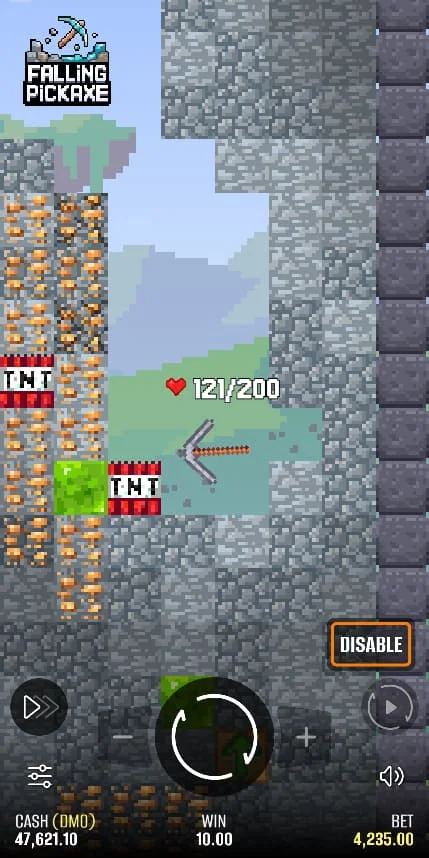
Falling Pickaxe screenshots


Frequently asked questions
Is there a winning strategy for Falling Pickaxe?
No strategy described here changes the published RTP or guarantees profit. Limits and fixed stakes make expenditure clearer, but gambling outcomes remain uncertain.
Does low volatility mean I cannot lose much?
No. It is a provider classification, not a cap on session losses. The amount you stake and how long you play still matter.
Should I increase the stake after several losses?
An increase raises the amount at risk and does not make the next outcome more favourable. Stop at the limit selected before play.
Can I time a tap to trigger TNT or an upgrade?
There is no verified basis for treating tap timing as a way to choose those features. They belong to the game round.
Are large demo winnings a useful signal?
They can help you recognise the display, but they do not predict a real-money result or demonstrate a profitable system.
Does Kelly justify a small stake in Falling Pickaxe?
Kelly requires a defensible positive edge and the relevant outcome probabilities. A published RTP below 100% or a short winning demo sample does not establish that edge.